
Copy GTM in 2026: The Music Has Changed… Are You Still Playing the Same Song?
By Meg Goetsch
In recent weeks I've found myself building "artifacts" left and right, but never stopped to ask what that word actually means, or what it says about what we're building now.
The Artifact and the Artifact
It's a word we've started using dozens of times a day: live artifact, shared artifact, static artifact, Claude artifact. But the word is older than software, older than computers, older than electricity.
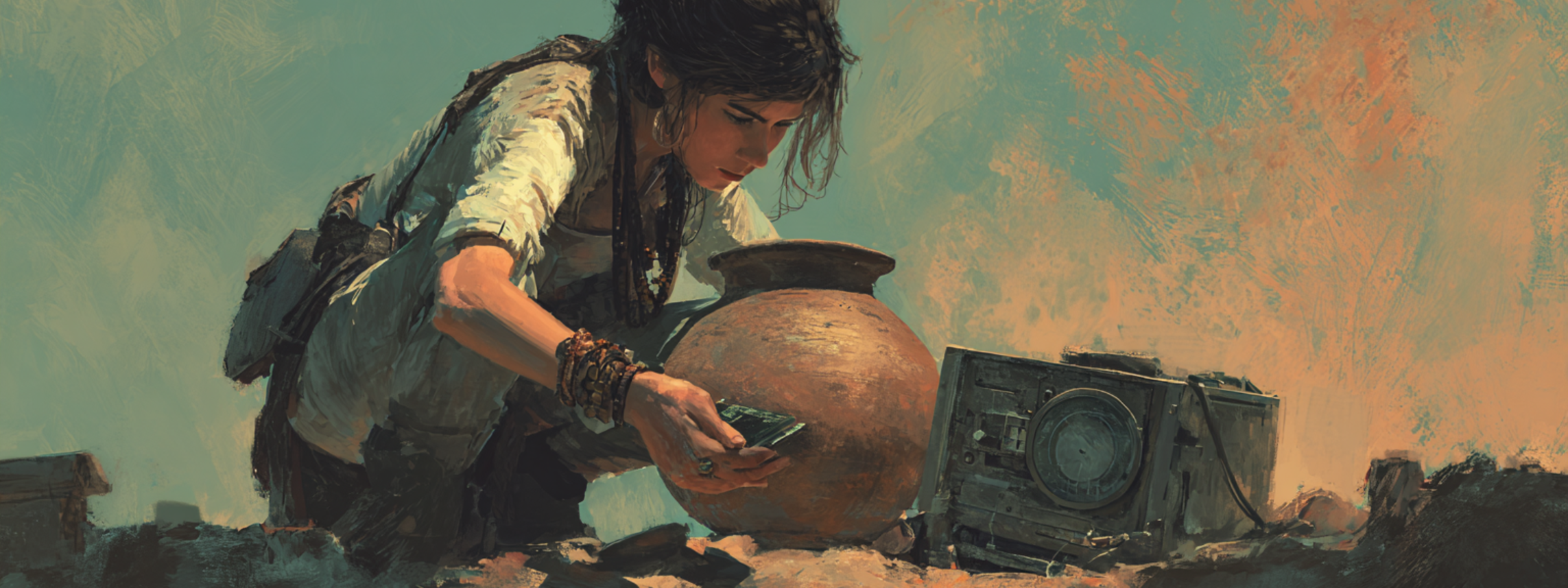
Archaeologists use it for objects pulled from the ground: clay pots, bronze blades, obsidian scrapers. Things made by human hands, encoded with the intelligence of whoever shaped them. We date entire civilizations by their artifacts. We understand vanished cultures by what they were able to make and what they left behind.
But here's what we forget: the archaeological artifact survived by accident, not intent. It's not the most important thing from that civilization. It's just what didn't rot. The pot, not the poem. The blade, not the treaty. History is shaped by the accident of what materials endured.
The Claude artifact has the opposite problem.
We are generating more intelligence, more structured thought, more connected reasoning than any period in history. And most of it is evaporating. It lives in a chat window. It doesn't persist between sessions unless you manually carry it somewhere else. Claude is catching up: projects give you persistent context, shared workspaces mean a team works against the same evolving output. But survival is still largely on us. The platform gives you the conditions. The operator has to choose where the artifact lands.
Most don't. Most treat the artifact as the output rather than the starting point. I got curious about what happens when you treat it as the beginning.
On the GTM side, customer signal comes from everywhere: calls, emails, support threads, Salesforce notes, NPS responses. Every touchpoint contains a real need, something a customer asked for, raved about, complained about, or had to work around. But that signal rarely makes it to the people building the product in any coherent form. It arrives as an anecdote, as a Slack message, as a comment in a monthly alignment meeting.
So I built an artifact that connects them. Claude pulls signal across those GTM sources, normalizes it, and maps it against open Jira tickets, surfacing where customer language and engineering priorities are already aligned, and where the gaps are. If a ticket doesn't exist, we are working toward auto-creation: from customer comment to ticket in seconds, solving problems before the customer gets blocked. The output lands in Jira, a system built to persist, to be owned, to survive.
The old version of this was a quarterly business review deck that was out of date before it finished rendering. This updates when the inputs do, and it lives somewhere real.
The clay pot lasted four thousand years because clay doesn't rot. Our artifacts will last because we are deliberate about where they land.
Meg Goetsch
Builds the operational engines that scale companies. She started her journey at MongoDB as employee #24, helping grow the company to 700 employees and a $1.2 billion valuation, and has since held senior operations roles at Forter, Vanta, Amazon Web Services, and JW Player.
At every stage from Series A to public, she has stood up operations spanning the full breadth of the business, not just a single function. Today, as SVP of Operations and AI Enablement at Coursedog, Higher Ed's Best Friend, Meg is passionate about how companies must evolve to keep pace with the shift to AI-enabled operations. She holds an MBA from Yale School of Management and a BA from Brown, and is based in Brooklyn, NY.